Monday Word: Indissolubly
Apr. 13th, 2026 06:58 am![[personal profile]](https://www.dreamwidth.org/img/silk/identity/user.png) stonepicnicking_okapi posting in
stonepicnicking_okapi posting in ![[community profile]](https://www.dreamwidth.org/img/silk/identity/community.png) 1word1day
1word1dayindissolubly ˌ[in-di-ˈsäl-yə-blē]
adverb
in a way that is impossible to take apart or bring to an end, or that exists for a very long time:
examples
But if Borges, who was buried in Geneva, is the more obviously European of the two men, in terms of stylistic propriety and range of literary reference, his fiction is indissolubly tethered to the avenues and plazas of Buenos Aires. A Surreal Tour of Nowhere in Particular by James Gardner 2011
It is true that, in making France great, he became great with her, and attached his name indissolubly to her grandeur. The Companions of Jehu by Alexandre Dumas (pere) 1836
origins
Indissoluble and its antonym dissoluble ("capable of being dissolved or disintegrated") both date their first print appearances to the 16th century, and both owe a debt to Latin dissolubilis, which means "dissoluble; capable of being dissolved." While the word dissolve in that gloss may call to mind the chemical process by which something mixed with a liquid becomes part of the liquid (as when salt or sugar dissolve in water), indissoluble primarily relates to other meanings of dissolve: "destroy" and "disintegrate," "terminate" and "annul." Something indissoluble—such as a treaty, contract, or vow—is permanent. The English word dissolve, in all its meanings, is a cousin to indissoluble and dissoluble. Dissolubilis derives from Latin dissolvere (from dis- + solvere, "to loosen") the source of our word dissolve.
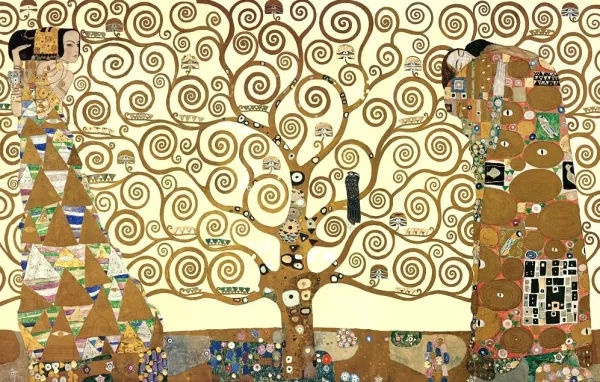
I don't know why Klimt's Tree of Life came up when I googled this word, but I love it so here it is
adverb
in a way that is impossible to take apart or bring to an end, or that exists for a very long time:
examples
But if Borges, who was buried in Geneva, is the more obviously European of the two men, in terms of stylistic propriety and range of literary reference, his fiction is indissolubly tethered to the avenues and plazas of Buenos Aires. A Surreal Tour of Nowhere in Particular by James Gardner 2011
It is true that, in making France great, he became great with her, and attached his name indissolubly to her grandeur. The Companions of Jehu by Alexandre Dumas (pere) 1836
origins
Indissoluble and its antonym dissoluble ("capable of being dissolved or disintegrated") both date their first print appearances to the 16th century, and both owe a debt to Latin dissolubilis, which means "dissoluble; capable of being dissolved." While the word dissolve in that gloss may call to mind the chemical process by which something mixed with a liquid becomes part of the liquid (as when salt or sugar dissolve in water), indissoluble primarily relates to other meanings of dissolve: "destroy" and "disintegrate," "terminate" and "annul." Something indissoluble—such as a treaty, contract, or vow—is permanent. The English word dissolve, in all its meanings, is a cousin to indissoluble and dissoluble. Dissolubilis derives from Latin dissolvere (from dis- + solvere, "to loosen") the source of our word dissolve.
I don't know why Klimt's Tree of Life came up when I googled this word, but I love it so here it is


(no subject)
Date: 2026-04-13 04:35 pm (UTC)The virility of the nude man's back covers the woman's body almost completely. As her face is invisible, too, the individuality of both characters remains concealed from us and seems to have merged into the compulsive and indissoluble union of the couple.
From Gustav Klimt 1862-1918: The World in Female Form (1989) by Gottfried Fliedl; English translation 1998 by Hugh Breyer: https://www.mt.artacademyplovdiv.com/pdf/Gustav%20Klimt-1862-1918-The%20World%20in%20Female%20Form.pdf